

Core Answer: What "Can Iran Attack US" Actually Means
Public queries about whether Iran can attack the United States usually combine three very different scenarios: direct attacks on the continental US, attacks on US military assets in the Middle East, and indirect attacks through aligned non-state networks. These are not equivalent. The continental scenario has the highest technical and political barriers. Regional scenarios are materially more plausible because geography, missile reach, maritime access, and proxy infrastructure all favor near-theater pressure over long-range power projection.
For strategic planning, the better framing is: what costs can Iran impose, on what timeline, and through which channels? Iran's force design has long prioritized distributed retaliation and uncertainty creation over classic expeditionary dominance. That means attack potential should be measured by cumulative disruption capacity, not one decisive strike concept. The most persistent risk channels are theater missile salvos, proxy-linked attacks on logistics nodes, cyber pressure on critical systems, and maritime incidents that force defensive resource diversion.
This architecture is consistent with the broader force profile in the Iran military strength assessment and the platform detail in the weapons systems briefing. It also intersects with the energy chokepoint analysis, because shipping risk and insurance repricing can turn limited military incidents into wider economic stress.
Plausible Attack Vectors Against US Interests
Iran has multiple pressure vectors, but each has distinct utility and risk. Ballistic and cruise missiles can threaten fixed or semi-fixed regional infrastructure within range bands that include major military installations and logistics corridors. Proxy-linked networks can generate deniable or semi-deniable pressure in Iraq, Syria, and maritime approaches. Cyber operations can target confidence and continuity by forcing disruption management costs even when physical damage is limited.
No vector is unconstrained. Missile operations face ISR pressure and interception. Proxy operations face attribution drift and escalation-control problems. Cyber campaigns face uncertain strategic payoff and potential retaliation in-kind. The point is not that one vector guarantees operational success, but that combined vectors create decision friction for defenders. In a crisis, that friction can compress policy timelines, increase miscalculation risk, and raise the cost of maintaining stable deterrence.
| Vector | Primary objective | Main constraint |
|---|---|---|
| Regional missile signaling | Demonstrate retaliation credibility and force dispersion. | Interception layers and launch survivability under ISR pressure. |
| Proxy-linked operations | Widen theater costs while preserving deniability windows. | Attribution hardening can trigger direct retaliation. |
| Cyber operations | Disrupt confidence, logistics, and command tempo. | Variable strategic effect and uncertain escalation pathways. |
| Maritime pressure | Raise shipping and insurance risk premiums rapidly. | Coalition naval response and convoy security frameworks. |
Range, Geography, and Why Continental Strike Is a Different Problem
The gap between threatening US forces in theater and threatening US mainland territory is substantial. Regional missile depth gives Iran meaningful coercive options against nearby military infrastructure. But sustained, reliable conventional strike capability against the continental United States is not established in open-source evidence. This distinction is essential because public discourse often confuses symbolic claims with fielded operational capacity.
Geography drives most outcomes. Iran's near-theater advantages include shorter operational lines, established proxy networks, and familiarity with maritime chokepoint dynamics. US advantages include surveillance depth, integrated air and missile defense, long-range strike capacity, and coalition logistics. The resulting balance favors intense regional pressure cycles over decisive long-distance attack campaigns.
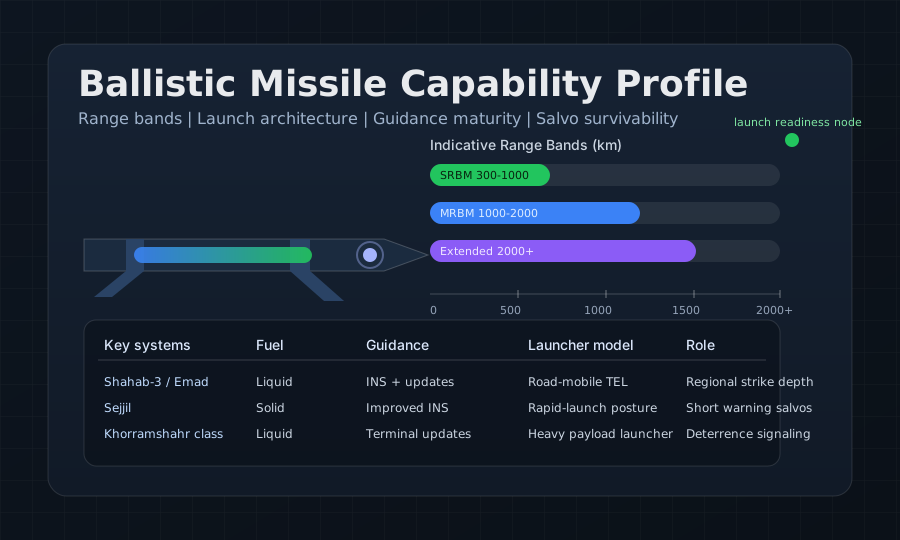
Readers tracking this distinction should pair this section with the dedicated US basing map page, where proximity and infrastructure exposure are mapped to operational timelines.
Proxy and Maritime Pressure: The Most Likely Escalation Channel
If tension escalates quickly, the most probable channel is distributed theater pressure rather than one spectacular attack. Proxy operations can target logistics continuity, force-protection posture, and political signaling. Maritime incidents near critical transit routes can shift insurance pricing before physical supply disruptions become severe. In practice, this means even limited kinetic action can produce wide strategic noise.
From a deterrence standpoint, Iran gains leverage when it can keep multiple pressure channels active at once. From a defensive standpoint, the US and partners reduce risk by maintaining fast attribution, resilient force protection, and clear escalation messaging. Where attribution lags and messaging diverges, crisis management windows narrow.

Scenario Table: 72-Hour and 7-Day Conflict Paths
Scenario planning works best when it separates immediate tactical events from second-order strategic effects. The table below outlines a practical escalation ladder with likely policy responses.
| Time band | Likely Iranian action pattern | Likely US/partner response | Strategic effect |
|---|---|---|---|
| 0-24 hours | Signaling launches, proxy posture hardening, maritime threat messaging. | Force protection surge, ISR intensification, emergency diplomatic channels. | High uncertainty and rapid media amplification. |
| 24-72 hours | Calibrated follow-on pressure through distributed channels. | Selective strikes, interception operations, coalition coordination. | Escalation-control stress test phase. |
| Day 4-7 | Either controlled de-escalation messaging or widened proxy friction. | Expanded deterrence signaling plus negotiated off-ramp attempts. | Path dependency forms; risk either compresses or broadens. |
The biggest uncertainty in any scenario is political decision sequencing. Tactical logic can favor restraint while domestic or alliance signaling pushes for escalation. Analysts should therefore score both military indicators and communication indicators when assessing whether a cycle is stabilizing or deteriorating.
Risk Control: What Lowers Probability of Uncontrolled Escalation
Deterrence stability improves when both sides maintain credible capability and credible communication. Capability without communication raises misread risk. Communication without capability weakens deterrence credibility. In this theater, the practical risk-control model includes standing military deconfliction channels, rapid incident attribution protocols, coordinated public messaging, and early diplomatic intervention by states able to talk to both sides.
Economic stabilization also matters. Energy and shipping markets can overreact during information gaps. Clear policy signals on convoy security, reserve release readiness, and escalation limits can reduce panic pricing. This is why military and economic policy teams must operate from a shared risk dashboard, especially during the first week of a crisis.
Historical context from the US-Iran conflict timeline shows that conflicts are most likely to widen when tactical incidents occur during periods of low diplomatic bandwidth and high rhetorical rigidity. Monitoring those conditions in advance is more effective than reactive crisis commentary after the fact.
FAQ: Can Iran Attack US
Can Iran attack US territory directly?
Direct sustained attack risk to the US mainland is lower than regional threat risk. The stronger and more immediate threat channel concerns US forces, bases, and shipping-linked interests in theater.
What is the most likely pressure channel in a crisis?
A combined pattern of proxy friction, missile signaling, cyber disruption, and maritime pressure is more likely than one dominant attack mode.
Would escalation automatically become full-scale war?
Not automatically. Many cycles remain limited, but control depends on attribution speed, communication discipline, and whether off-ramp channels activate early.