Ground Endurance
Large manpower and distributed mobilization support prolonged attrition tolerance.

Iran military strength is strongest in regional deterrence tools such as missiles, drones, and maritime disruption capacity rather than in conventional airpower parity with the United States or Israel. The key analytic point is that Iran's force design is built to absorb attrition and impose escalation costs across multiple fronts instead of winning fast, high-tech maneuver campaigns.
Iran military strength in 2026 is best understood as a hybrid deterrence model, not a single ranking score. This briefing separates conventional force quality from missile inventory depth, maritime denial tools, and proxy leverage, then compares those layers against Israeli and US campaign strengths.

This page is organized as a force-model walkthrough: conventional depth, asymmetric leverage, and cross-theater escalation utility.
Large manpower and distributed mobilization support prolonged attrition tolerance.
Littoral denial tools drive insurance and routing pressure in Gulf chokepoints.
Airpower asymmetry versus missile and proxy depth tradeoffs define campaign outcomes.
Escalation tempo and survivability matter more than static ranking tables.
Iran's military is best described as a hybrid deterrent architecture rather than a force optimized for long-distance conventional campaigns. The regular military (Artesh) still handles territorial defense, navy patrol missions, and legacy airpower functions. The Islamic Revolutionary Guard Corps (IRGC) carries the regime-protection mission and controls key strategic portfolios: missile forces, drone programs, maritime harassment capacity, and expeditionary advisory networks.
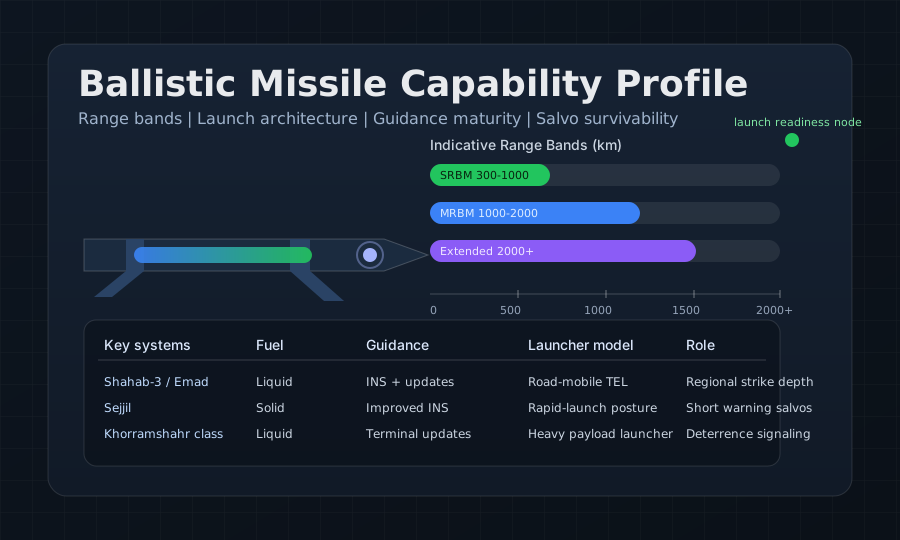
On raw numbers, Iran fields large active manpower and sizable missile inventories, but much of its conventional fleet includes aging platforms with sustainment constraints. The most resilient elements are mobile launchers, distributed storage, decentralized command nodes, and a doctrine focused on salvo effects rather than precision dominance. That doctrine links directly to the weapons systems briefing and to Hormuz disruption scenarios where maritime pressure and missile signaling intersect.
Public discussion often asks what the IRGC is in Iran and whether it duplicates the national military. The answer is institutional layering. Artesh maintains formal state military functions. IRGC operates as both elite military actor and political-security structure with economic, intelligence, and expeditionary footprints.
| Dimension | Artesh (Regular Forces) | IRGC |
|---|---|---|
| Primary mission | Territorial defense and conventional operations | Regime security, strategic deterrence, external influence operations |
| Core strengths | Force size, command continuity, doctrinal planning | Missiles, drones, naval swarming, proxy integration |
| Command behavior | Hierarchical and branch-centric | Networked, politically embedded, often faster decision loops |
| External projection | Limited | Higher via Quds Force advisory and partner networks |
The IRGC-Artesh split matters for escalation modeling. Even where central command messaging appears unified, operational initiatives can emerge from different institutional logics. Analysts tracking Iran military ranks or force structure should therefore map actor-specific incentives, not just platform inventories.
Iran's ground order of battle emphasizes quantity, territorial coverage, and layered mobilization. Main battle tank fleets and armored units remain relevant for border defense and internal control, but modernization quality is uneven. Equipment age, sensor integration gaps, and logistics readiness constrain sustained high-intensity maneuver warfare against peer airpower.
Where ground forces gain practical leverage is in distributed artillery, short-range rocket pressure, and integration with reserve/paramilitary ecosystems. This approach can absorb initial attrition while preserving the capacity for prolonged regional friction. In that sense, the question of how many people are in Iran military formations matters less than unit readiness and command survivability under strike pressure.
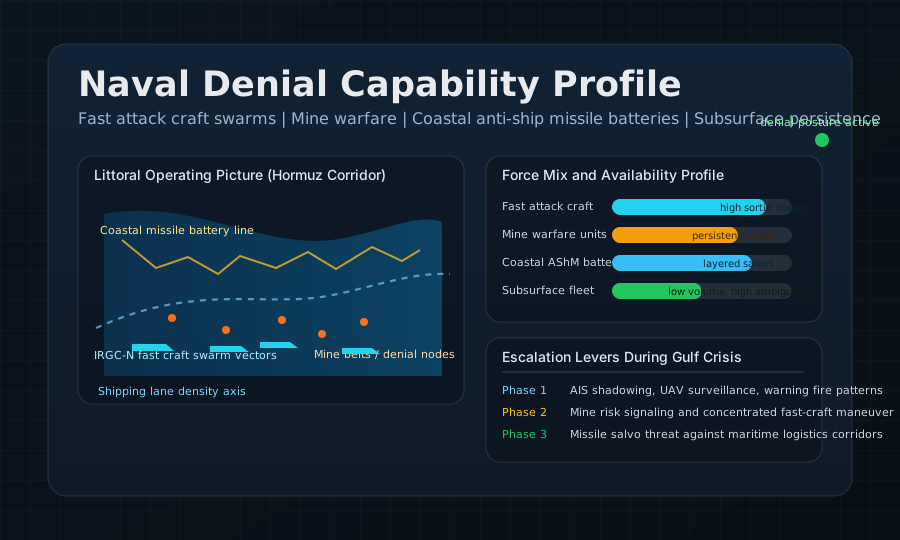
Iran operates parallel naval structures: the regular navy for broader patrol and symbolic blue-water messaging, and IRGC Navy for high-tempo littoral operations in the Gulf. This dual system supports maritime ambiguity. Fast-attack craft, anti-ship missiles, coastal radars, and naval mines create uncertainty in chokepoints even when outright closure remains unlikely.
For readers asking how big Iran's navy is, fleet tonnage is only part of the answer. The more relevant metric is whether Iran can force shipping insurers and military planners to price in disruption risk. The oil-energy briefing explains how even short disruption windows can affect oil price expectations.
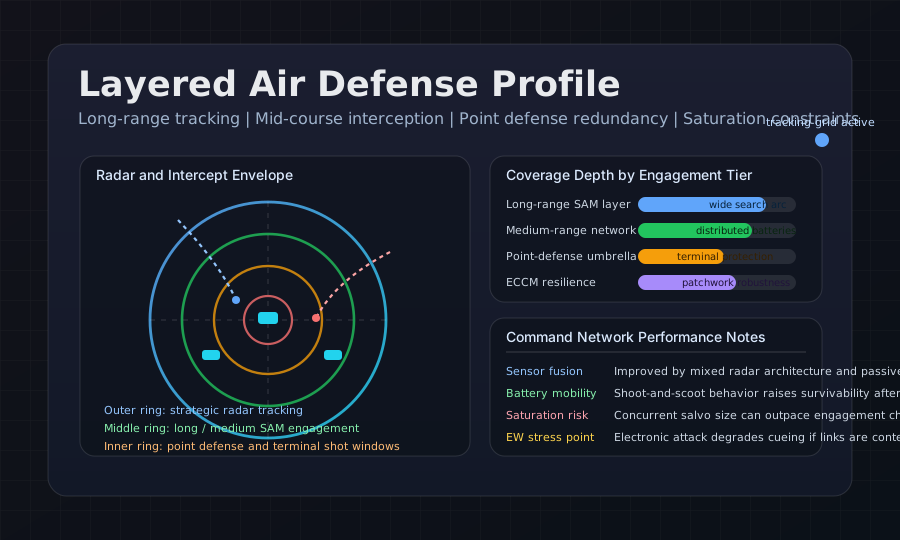
Iran's combat aircraft inventory contains legacy platforms with maintenance and availability constraints, limiting sustained offensive reach in contested airspace. This weakness is partly offset by layered air defense, including domestically developed systems and imported architectures such as S-300 variants.
The practical objective is to raise strike costs and delay air campaign tempo rather than guarantee air denial. This is why search interest in Iran air defense systems and S-300 Iran deployments often reflects survivability concerns more than claims of parity. Additional platform-level coverage appears in the air defense section.
Iran's asymmetric toolkit is a force multiplier that compensates for conventional gaps. Partner networks in Lebanon, Iraq, Syria, and Yemen can create distributed pressure on adversary logistics, air defense posture, and political decision-making. The strategic function is not always battlefield victory; it is often escalation management through controlled uncertainty.
Cyber operations and information campaigns complement this model by targeting narratives, infrastructure confidence, and response timelines. For broader context on alliance and proxy architecture, see the US-Iran-Israel triangle analysis.
High-volume queries like iran vs israel military power and israel vs iran military comparison usually imply a single winner model. In practice, outcomes depend on campaign scope, duration, external support, and escalation goals.
| Area | Iran | Israel |
|---|---|---|
| Conventional airpower | Limited by aging fleet and sustainment | High readiness, advanced aircraft, integrated ISR |
| Missile depth | Large inventory and regional strike depth | Smaller inventory but stronger integration and precision options |
| Air defense posture | Layered but stress-tested under saturation | Multi-tiered missile defense with mature battle management |
| Proxy leverage | Extensive regional partner network | Strong intelligence penetration and strike capability |
Israel generally retains decisive advantages in intelligence fusion, precision strike, and sortie quality. Iran retains advantages in distributed retaliatory capacity and ability to widen the theater via partners.
For the query us military vs iran military, the structural gap is clear. The United States holds overwhelming superiority in joint air-sea projection, logistics depth, ISR coverage, and precision strike throughput. Iran's model assumes this and seeks to raise operational and political costs through regional missile salvos, maritime disruption risk, and distributed escalation.
| Dimension | Iran posture | US posture |
|---|---|---|
| Power projection | Regional, mostly near-home theater | Global, carrier and airbase enabled |
| Sustainment | Constrained under prolonged conflict | High endurance with allied logistics network |
| Deterrence method | Cost-imposition and retaliation risk | Dominance through rapid joint operations |
Relevant context on map us military bases middle east posture is covered in the geopolitical page's theater map section.
No. US forces retain clear conventional superiority. Iran's strategy focuses on attrition and deterrence by punishment, not matching US force structure.
Open estimates generally place active personnel around 600,000+ across regular and IRGC structures, with additional mobilization layers.
Rankings vary by index methodology. Capability is uneven: stronger in missiles and regional denial than in modern air force quality or expeditionary logistics.
Most headlines about force size understate the decisive variable: readiness under pressure. Iran can mobilize significant manpower, but readiness differs sharply by branch, mission set, and theater distance. Units assigned to homeland defense and missile operations typically have better continuity plans than heavy maneuver formations that depend on aging armored fleets, constrained spare parts supply, and vulnerable maintenance hubs. That unevenness matters because modern campaigns are won through sortie generation, logistics resilience, and command survivability, not order-of-battle totals alone.
Iran's commanders have adapted to this reality by prioritizing distributed storage, launcher mobility, hardened nodes, and decentralized execution. In practical terms, Tehran accepts tactical losses in exchange for strategic persistence. This is why analysts studying iran military equipment or iran military ranks should evaluate sustainment pathways and replacement cycles, not only platform counts. A force can look large on paper but degrade rapidly if fuel distribution, battle-damage repair, and sensor networks collapse after the first strike wave.
| Readiness factor | Current Iranian advantage | Primary limitation |
|---|---|---|
| Missile force survivability | Mobile launchers and dispersed storage reduce single-point vulnerability. | Sustained ISR pressure can narrow launch windows over time. |
| Air defense continuity | Layered architecture creates defensive depth at strategic sites. | Saturation strikes and electronic warfare can degrade network coherence. |
| Ground force endurance | Large manpower pool supports prolonged defensive operations. | Aging armor and uneven logistics constrain offensive maneuver quality. |
| Command redundancy | Parallel IRGC and Artesh structures provide backup channels. | Political-military overlap can slow unified campaign decisions. |
Readiness assessment also links directly to escalation economics. If Iran can keep enough launch capacity alive, opponents must maintain expensive force-protection postures for longer periods. That cost-imposition logic is part of the same strategic architecture discussed in the weapons systems briefing, the Hormuz disruption analysis, and the broader conflict timeline that shows how crises recur when neither side secures decisive de-escalation terms.
A practical way to test iran military strength claims is to model the first 72 hours of a regional crisis. In hour 0-12, Iran's objective is signaling and survivability: dispersing key assets, increasing air-defense readiness, and demonstrating launch capacity. In hour 12-36, the goal shifts to cost-imposition, typically via calibrated missile salvos, maritime harassment risk, and proxy-linked pressure that complicates adversary targeting priorities. In hour 36-72, Tehran usually seeks to shape negotiation terms by showing that further pressure will widen theater costs.
This sequence does not imply guaranteed success. It reflects an operating concept built around uncertainty management. Iran does not need to dominate every domain to influence decision-making; it needs to preserve enough retaliatory credibility that opponents factor broader economic and political spillovers into next-step choices. When that credibility is weak, deterrence erodes quickly. When it is credible, even limited capabilities can produce strategic pause windows.
For planners, this means campaign analysis should combine military and non-military metrics: launcher survivability, shipping insurance shock, alliance cohesion, and diplomatic off-ramp viability. Looking only at firepower rankings misses the mechanism Iran relies on most, which is sustained uncertainty across military and economic systems. That mechanism explains why periods of high tension often stabilize temporarily without resolving underlying conflict drivers.