
Current Status: Enrichment Levels and Stockpile Context
Iran's nuclear trajectory is defined by three measurable variables: enrichment percentage, stockpile mass at each enrichment tier, and installed centrifuge capability. Public debate often compresses these variables into binary statements, but policy risk analysis depends on their interaction over time.
What is enriched uranium? It is uranium in which the fissile U-235 share is increased through centrifuge cascades. What is uranium enrichment in strategic terms? It is the pace-control mechanism of the program. As enrichment levels rise, the marginal time needed to reach weapons-grade thresholds can shrink, changing breakout calculations even if no public decision to weaponize has been declared.
| Indicator | Why it matters | Monitoring signal |
|---|---|---|
| Enrichment tier mix | Higher tiers reduce additional processing time | IAEA reporting cadence and declared inventories |
| Centrifuge deployment | Impacts throughput and resilience to disruption | Facility modifications and cascade configuration |
| Verification access | Shapes uncertainty and warning time | Inspector access and monitoring continuity |
Key Facilities: Natanz, Fordow, Bushehr, Isfahan, and Arak
Queries for nuclear facilities in Iran map reflect a practical need: where are the core nodes, and what roles do they play? Facility type matters because a fuel-cycle system is distributed by design.
Natanz
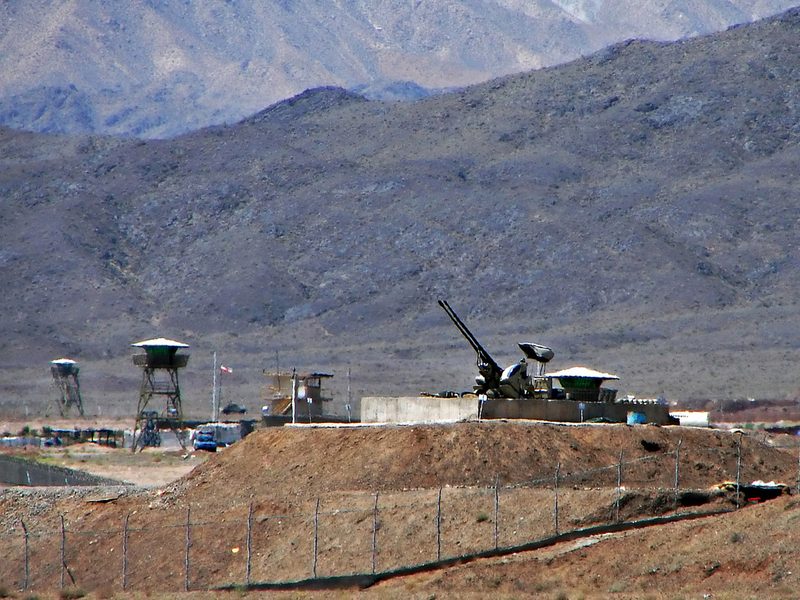
Location profile: central Iran. Role: major enrichment complex. Status logic: central to throughput calculations; frequently referenced in natanz iran map searches because of repeated sabotage and hardening cycles.
Fordow
Location profile: near Qom, underground site. Role: high-sensitivity enrichment node. Status logic: often central in strike planning debates due to buried infrastructure and survivability assumptions.
Bushehr Reactor
Location profile: Gulf coast. Role: civilian power reactor. Status logic: operationally distinct from enrichment complexes yet politically tied to broader Iran nuclear narrative.
Isfahan
Location profile: central industrial corridor. Role: conversion and fuel-cycle support activities. Status logic: supports upstream and downstream pathways.
Arak
Location profile: central-western Iran. Role: heavy-water associated infrastructure. Status logic: redesign and compliance debates repeatedly surface in negotiations.
Iran Nuclear Sites Map and Clickable Facility Reference
The map below consolidates common search intent around iran nuclear sites map and map of iran nuclear sites. Select each pin to jump to its facility profile.
Timeline of Nuclear Development
Iran's program evolved through pre-1979 foundations, post-war reconstruction, clandestine exposure periods, negotiation cycles, and post-JCPOA reacceleration. The exact mix of declared and undeclared activity has shifted, but the strategic rhythm remains consistent: technical progress, diplomatic pressure, partial restraint, then renewed technical adaptation.
- Shah era to early post-revolution: program foundations with long interruptions.
- 2000s exposure period: international scrutiny intensifies around enrichment infrastructure.
- 2015 JCPOA phase: constraints and verification mechanisms tighten breakout assumptions.
- Post-withdrawal period: constraints erode, enrichment and stockpile trajectories change.
- Current phase: technical capability growth and diplomacy remain in tension.
For full political chronology beyond the nuclear domain, see the interactive US-Iran conflict timeline.
The JCPOA and Its Collapse
The Joint Comprehensive Plan of Action was designed as a sequencing framework: sanctions relief in exchange for measurable technical limits and verification access. Its erosion did not simply remove a document; it removed a calibrated timing mechanism. That shift matters for current searches on nuclear iran talks and US-Iran nuclear talks because negotiations now start from degraded trust and altered technical baselines.
Any renewed framework must reconcile three incompatible pressures: Iran's desire for durable economic relief, US and European demand for stronger verification confidence, and Israeli concerns over residual breakout and missile risks. This triad links directly to the broader geopolitical triangle.
Breakout Scenario Analysis: What Would the World See?
What happens if Iran gets nuclear weapons capability? Analysts generally watch for a sequence of indicators rather than a single trigger: abrupt stockpile reallocation, unusual centrifuge reconfiguration, access restrictions, accelerated activity at hardened sites, and concurrent strategic signaling by regional actors.
Scenario bands
| Scenario | Observable indicators | Likely international response pattern |
|---|---|---|
| Managed tension | Incremental technical steps with continued inspections | Pressure plus negotiation attempts |
| Compressed breakout risk | Higher enrichment concentration and reduced transparency | Emergency diplomacy and covert disruption pressure |
| Crisis threshold | Sustained denial of monitoring plus rapid technical moves | High probability of preemptive military signaling |
FAQ: Iran Nuclear Program
Does Iran have a nuclear weapon?
Public open-source and official reporting does not indicate declared deployment of an Iranian nuclear weapon. Debate centers on capability trajectory and intent signaling.
How close is Iran to a bomb?
Closeness depends on assumptions about enrichment material, centrifuge throughput, and the additional weaponization phase after fissile material production.
What is uranium enrichment?
It is the process of increasing U-235 concentration. Higher concentrations reduce further technical steps required for weapons-grade material.
What is breakout time?
Breakout time estimates how quickly enough fissile material for one weapon could be produced under a deliberate decision pathway.
Monitoring Architecture: What Analysts Watch Week to Week
Public understanding of nuclear risk often spikes only during dramatic headlines, but serious monitoring is continuous and indicator-driven. Analysts track declared enrichment updates, satellite imagery of facility activity, procurement signals, and inspection access changes to estimate how quickly capability could move. No single signal is decisive. Instead, confidence rises or falls as multiple indicators converge across technical, diplomatic, and operational data streams.
Inspection continuity is particularly important because uncertainty itself is strategic. When access narrows, outside actors have less confidence in warning timelines, and that can accelerate coercive policy options even if no definitive breakout move is observed. This is why debates about "how close is Iran to a bomb" should include confidence bands, not just single-date claims. A low-confidence environment can be destabilizing even without immediate weapons deployment evidence.
| Monitoring channel | Useful signal | Main limitation |
|---|---|---|
| IAEA reporting | Official enrichment and stockpile disclosures over time. | Cadence and access gaps can delay full visibility. |
| Commercial satellite imagery | Construction, excavation, perimeter activity, and logistics patterns. | Cannot directly confirm isotopic composition or internal process state. |
| Open-source procurement tracing | Components and material flow patterns related to fuel-cycle capacity. | Dual-use items are difficult to attribute with certainty. |
| Diplomatic signaling | Negotiation posture, red lines, and sequencing preferences. | Statements can be tactical and aimed at bargaining leverage. |
For readers following policy outcomes, the monitoring picture should be read together with regional alliance behavior, military deterrence posture, and historical escalation precedents. Nuclear risk rarely moves in isolation from broader regional threat signaling.
Policy Options: Containment, Negotiation, and Coercive Pressure
Most governments evaluating Iran's nuclear trajectory operate across three imperfect options: negotiated limits, pressure-and-containment, or coercive disruption. Negotiated limits can extend breakout timelines but require reciprocal trust and enforceable verification. Pressure-and-containment can constrain economic and technical pathways but often drives adaptation and opacity. Coercive disruption may delay capacity temporarily yet can increase long-term hardening incentives and retaliation risks.
The practical policy challenge is sequencing. Durable agreements usually require simultaneous movement on sanctions relief terms, verification architecture, and regional security assurances. If sequencing collapses, each side sees concessions as asymmetric risk. That pattern has repeatedly constrained nuclear diplomacy since the post-JCPOA period and explains why short negotiation windows often close quickly after regional military shocks.
From a market and security perspective, the most stabilizing path is often incremental: restore monitorable limits first, then widen scope toward missile, regional, and sanctions architecture questions. Maximalist all-at-once negotiations look decisive but frequently break under domestic political pressure. The structured alternative is slower but historically more resilient.
Verification Gaps and Confidence Scoring
Analysts should treat transparency as a measurable variable, not a binary state. A practical confidence score combines inspection access continuity, reporting cadence, and independent corroboration from commercial imagery and procurement indicators. When two of those three channels weaken, risk models should widen uncertainty bands even if no single dramatic indicator appears. That adjustment improves planning because policy responses are often triggered by confidence loss as much as by technical change.
Confidence scoring is also useful for communicating uncertainty to non-technical audiences. Rather than claiming exact timelines, analysts can describe high-confidence, medium-confidence, and low-confidence ranges tied to evidence quality. This keeps assessments rigorous and reduces overreaction to isolated data points.