

Map Baseline: What This Layer Shows and What It Does Not
Any map of US military bases in the region should be read as a reference baseline, not a real-time force-disposition tracker. Publicly discussed locations represent a mix of permanent infrastructure, rotational presence, access agreements, and mission-specific staging nodes. Capacity and usage can shift by operation, threat level, and diplomatic conditions.
Because of this variability, responsible analysis combines static location data with dynamic indicators such as sortie tempo, maritime incident frequency, missile activity, and political signaling. A base that appears geographically distant from immediate hostilities can still become strategically central through command, logistics, or ISR functions.
Base-by-Base Reference Table
The table below summarizes widely referenced hubs and their strategic role in crisis management. Mission roles can overlap and vary by period.
| Location | Commonly cited installation role | Primary mission value | Risk exposure profile |
|---|---|---|---|
| Al Udeid, Qatar | Major air and command hub | Air operations coordination and theater command support. | High strategic value; indirect pressure risk through regional escalation. |
| Bahrain naval complex | US naval command presence | Maritime security, convoy coordination, and deterrence signaling. | Sensitive to Gulf maritime incident escalation. |
| Kuwait facilities | Logistics and ground-force support | Staging, sustainment, and mobility support for regional operations. | Exposed to theater missile and proxy risk dynamics. |
| UAE partner sites | Air and missile-defense cooperation | Regional integration and response flexibility. | Risk varies by mission tempo and proximity to contested corridors. |
| Jordan (Muwaffaq Salti) | Air mission support | Operational depth for Levant-facing contingencies. | Moderate exposure; escalates with regional spillover events. |
| Iraq mission hubs | Advisory and force-protection footprint | Counterterror and stabilization-linked mission continuity. | High proxy friction sensitivity. |
| Turkey (Incirlik) | NATO-linked regional access | Strategic logistics and alliance interoperability options. | Exposure shaped by alliance politics and theater stress. |
| Saudi support nodes | Integrated defense cooperation | Air-defense and regional reassurance posture. | Exposure tied to broader Gulf deterrence cycle. |
Mission Logic: Why These Bases Exist as a Network
US force posture in the region is networked rather than single-node. Some locations provide command-and-control throughput, others provide logistics depth, others provide access for air and maritime response. Network logic improves resilience because stress on one node does not automatically collapse the whole system.
However, networked architecture also creates coupling risk: political or military stress in one area can force rapid mission redistribution elsewhere. That redistribution is manageable when planning and alliance coordination are strong, but can become costly when crisis tempo accelerates faster than diplomatic signaling.
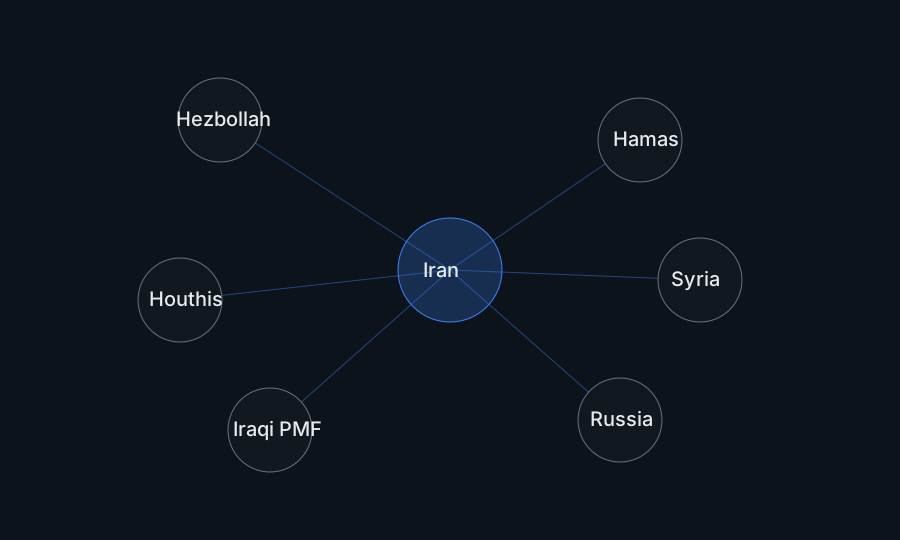
Readers can pair this section with can iran attack us for threat-channel analysis and triangle strategy for multi-actor escalation logic.
Risk Overlay: Missile Reach, Proxy Activity, and Maritime Exposure
A useful map layer adds three overlays: regional missile envelopes, proxy activity corridors, and maritime chokepoint dependence. This approach avoids simplistic "near vs far" assumptions and instead models how risk transmits across systems. A base geographically distant from a launch area may still face high operational risk if it anchors critical command flow or logistics throughput.
Risk weighting should be dynamic. During routine conditions, mission value often dominates planning. During crisis periods, survivability and continuity dominate. Robust risk models update these weights in near real time based on incident frequency and policy signaling.

How to Use This Map for Weekly Strategic Monitoring
For weekly monitoring, start with static location awareness and then update five indicators: force-protection posture changes, regional incident tempo, maritime insurance spreads, official messaging discipline, and alliance-coordination signals. Together these indicators provide a practical "base network stress index" that is more useful than static location snapshots.
This method also helps content teams avoid repetitive analysis. One week can focus on logistics resilience, another on deterrence signaling, another on maritime coupling, another on diplomatic risk compression. The same map supports multiple analytical angles when overlays are explicit.
FAQ: Map US Military Bases Middle East
Why are these base locations important?
They enable regional response speed, coalition interoperability, and sustained logistics in crisis environments.
Do all bases have the same mission type?
No. Functions vary across command, logistics, air operations, maritime operations, and advisory missions.
How should I interpret risk from this map?
Use dynamic overlays (missile, proxy, maritime, diplomacy) rather than static distance alone.