
Iran's Oil Industry Overview
Iran remains one of the largest hydrocarbon holders globally, but export monetization is constrained by sanctions, shipping risk, and financial channel restrictions. Iran crude production can fluctuate with domestic infrastructure maintenance, sanctions enforcement intensity, and external demand signals, especially from Asian importers willing to accept risk-adjusted pricing.
Searches for what natural resources Iran has or what are oil reserves often mix geological potential with market-access reality. Reserves represent underground availability; effective output depends on investment, technology access, insurance conditions, and transport freedom. Those constraints make sanctions and maritime security as important as geology.
Strait of Hormuz Deep Dive: Why This Chokepoint Matters
The Strait of Hormuz connects Gulf production zones to global seaborne trade routes. Roughly one-fifth of internationally traded petroleum liquids transits the corridor in normal conditions. Because the channel is geographically narrow, even localized incidents can produce outsized insurance and routing responses.
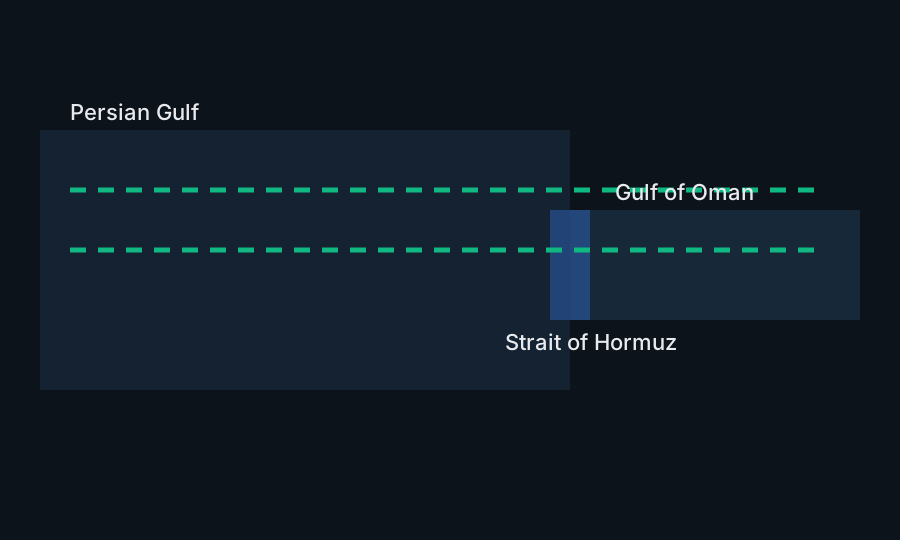
Is the Strait of Hormuz international waters? Legally and operationally, transit frameworks involve territorial seas and recognized navigation rights; in practice, risk pricing is driven by military signaling and incident frequency. For military posture context, pair this section with Iran naval strategy analysis.
Sanctions Impact on Iran Oil Exports
Iran oil sanctions affect lifting arrangements, ship ownership opacity, banking settlement channels, and discount structures. Over time, adaptation mechanisms have included ship-to-ship transfers, blended cargo documentation, and flexible destination routing. This means headline sanctions policy does not always map linearly to physical export volume.
Queries like do we buy oil from Iran are best answered at two levels: formal direct import legality and indirect market exposure through global pricing and intermediated flows. Even where direct imports are constrained, benchmark prices still reflect perceived disruption risk around Iran-linked supply.
| Sanctions pressure point | Observed adaptation pattern | Residual vulnerability |
|---|---|---|
| Banking and settlement controls | Alternative payment routes, non-dollar channels | Counterparty and compliance risk |
| Shipping and insurance | Flag-switching, insurer substitution, routing opacity | Higher freight and seizure risk |
| Buyer compliance pressure | Discounted barrels to risk-tolerant buyers | Concentrated demand dependency |
Oil Price Scenario Modeling
Oil price Iran conflict modeling should be treated as scenario logic, not point forecasts. The table below captures directional impacts under escalating conditions.
| Scenario | Transit status | Likely oil market response |
|---|---|---|
| No conflict baseline | Routine shipping, normal insurance terms | Prices driven by macro demand/supply fundamentals |
| Limited strikes | Short-lived routing caution | Temporary risk premium, volatility spike |
| Regional war | Frequent security incidents | Sustained upside pressure and wider futures spreads |
| Hormuz closure attempt | Severe transit disruption | Acute repricing, emergency strategic stock draw expectations |
What would happen if the Strait of Hormuz closed? Initial market reaction would likely outrun physical shortages because finance, freight, and insurer behavior moves first. Duration is the key determinant of whether a spike becomes a prolonged shock.
Global Energy Dependency and Vulnerability Ranking
Countries with high import dependency and limited strategic stock flexibility are most exposed to Hormuz instability. East and South Asian importers typically face the sharpest immediate risk, while diversified producers and pipeline-linked markets can absorb disruption longer.
| Country/Market | Exposure to Hormuz transit | Vulnerability rank | Reason |
|---|---|---|---|
| India | High | Very High | Large import demand and significant Gulf share in crude sourcing. |
| South Korea | High | Very High | Heavy refinery dependence on Gulf crude grades. |
| Japan | High | High | Substantial Gulf exposure but strong strategic reserves. |
| China | Medium-High | High | Large absolute demand with partial diversification and reserve buffers. |
| EU (aggregate) | Medium | Medium | Broader supply optionality, though freight and insurance shocks still transmit. |
| United States | Low direct | Medium | Lower direct import reliance, but high exposure to global benchmark price spikes. |
The policy response sequence usually includes strategic reserve coordination, convoy planning, diplomatic de-escalation, and rerouting to alternative export terminals where available. Those responses can cap long-duration panic but may not prevent short-term price surges.
Historical Precedents: 1973, 1979, Gulf War Comparisons
Past oil shocks show that market psychology can amplify physical disruption. The 1973 embargo highlighted policy-driven scarcity fears; the 1979 shock showed how regime instability can reverberate globally; the 1990-91 Gulf War period demonstrated the stabilizing role of coordinated producer response and stock release strategies.
Has the Strait of Hormuz been closed? Not as a sustained modern precedent, but repeated confrontation episodes demonstrate that near-closure risk alone can lift insurance and freight costs. This is why energy analysts monitor naval signals and missile posture together with actual cargo flows.
FAQ: Oil and Hormuz
What would happen if Iran closes the Strait of Hormuz?
Expect immediate shipping disruptions, higher risk premiums, and rapid multinational naval response aimed at restoring passage and deterring extended blockage.
Has the Strait of Hormuz been closed before?
No long-duration full closure has held in modern periods, but incident spikes have repeatedly disrupted risk pricing and shipping behavior.
Do we buy oil from Iran?
Direct purchases into sanctioned markets are restricted, yet global benchmarks still respond to Iran-linked supply and transit risk through indirect channels.