

US-Iran Relations Timeline: 1953 to Present
The US-Iran relationship is cyclical: covert competition, negotiated openings, sanction escalation, and crisis management phases. The 1953 coup remains a foundational memory in Iranian strategic culture, while the 1979 revolution and hostage crisis reshaped US doctrine toward containment and coercive pressure.
Subsequent decades alternated between limited tactical coordination and broader rivalry, culminating in major friction around sanctions architecture, regional militia networks, and nuclear diplomacy. For readers specifically seeking has Iran attacked the US historical context, the dedicated interactive timeline breaks down incidents by category and date.
| Period | Key event | Strategic effect |
|---|---|---|
| 1953 | Coup against Mossadegh | Long-term sovereignty grievance embedded in Iranian doctrine. |
| 1979-1981 | Revolution and hostage crisis | Break in formal relations and sanctions-era baseline. |
| 2002-2015 | Nuclear disclosure to JCPOA | Negotiated constraints with expanded verification architecture. |
| 2018-2020 | US withdrawal from JCPOA and Soleimani crisis | Escalation with direct military signaling and sanction intensification. |
| 2021-present | Partial diplomacy with repeated regional flashpoints | Persistent unstable deterrence without durable settlement. |
Israel-Iran Shadow War: Covert Action, Cyber Operations, and Proxy Pressure
The Israel-Iran contest is often called a shadow war because key actions occur below declared-war thresholds: covert sabotage, intelligence operations, targeted strikes, and cyber disruption. This dynamic allows strategic signaling without immediate full-scale mobilization, but it also increases miscalculation risk.
Recent escalation cycles show a pattern: one side seeks calibrated deterrence restoration, the other seeks credibility recovery, and both frame actions as bounded. The problem is that repeated bounded actions can produce cumulative instability, especially when proxies or third-party actors operate under partial control.
- Assassination and sabotage track: infrastructure and personnel targeting to slow capability growth and reshape deterrence narratives.
- Cyber track: intrusion and disruption operations aimed at command resilience, industrial confidence, and strategic signaling.
- Proxy conflict track: pressure through Lebanese, Syrian, Iraqi, and maritime fronts to raise operational costs indirectly.
Iran's Regional Alliance Network and Proxy Architecture
Who are Iran allies in the Middle East is not a simple treaty question. Iran's network is layered: formal state relations, semi-formal security partnerships, and proxy or aligned non-state organizations with different command dependence levels.
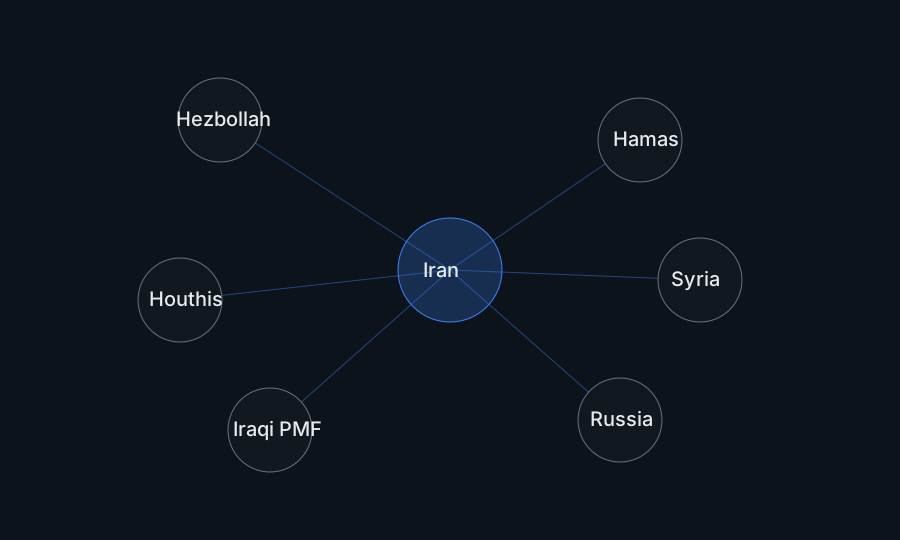
| Actor | Relationship type | Strategic function |
|---|---|---|
| Hezbollah | Long-term partner network | Deterrence depth against Israel |
| Houthis | Aligned pressure actor | Red Sea and regional signaling leverage |
| Hamas | Political-military alignment with variable operational depth | Adds pressure vectors in Israel's southern and regional security calculus. |
| Iraqi PMF elements | Variable alignment | Theater pressure against US presence |
| Syrian state ties | Security partnership | Logistics corridor and presence continuity |
Searches such as are Qatar and Iran allies or are China and Iran allies illustrate public confusion between tactical coordination and formal alliance. The analytical standard should be issue-specific alignment, not binary ally labels.
Russia-Iran-China Axis: Cooperation and Limits
Is Iran a Russian ally and is Iran allied with China are high-interest questions that require precision. There is strategic convergence on selected issues, especially sanctions resistance, military technology exchange, and diplomatic balancing in multilateral forums. But convergence does not imply a fully integrated military bloc.
Russia-Iran military cooperation has expanded in areas like drones and defense-industrial exchange narratives, while China-Iran relations emphasize energy and economic continuity. Both relationships are shaped by pragmatic bargaining, not unconditional security guarantees.
| Track | Russia-Iran dynamic | China-Iran dynamic |
|---|---|---|
| Military cooperation | Higher profile in drone and defense-technology exchange narratives. | More limited direct military integration; stronger focus on strategic signaling. |
| Economic ties | Sanctions-driven transactional alignment with constraints. | Energy purchasing and infrastructure-finance positioning. |
| UN dynamics | Frequent diplomatic balancing against Western pressure timing. | Selective support calibrated to broader great-power priorities. |
US Military Bases Around Iran: Why Geography Matters
Search interest in map us military bases middle east reflects a structural reality: proximity shapes deterrence and response timelines. Key basing arcs in the Gulf, Iraq, and broader CENTCOM footprint shorten decision cycles in crises involving Iran's missile and proxy networks.

In UN and diplomatic settings, this triangle can constrain Western pressure speed, but it does not eliminate Iran's structural economic vulnerabilities or regional friction costs.
Scenarios and Outlook: What Happens if US Attacks Iran?
What happens if US attacks Iran depends on strike scope, target set, and duration. Three broad pathways are useful:
| Scenario | Immediate consequence | Secondary effects |
|---|---|---|
| Limited punitive strike | Short retaliation cycle, missile and proxy signaling | Temporary oil risk premium and heightened force protection posture |
| Extended campaign | Distributed retaliation across regional nodes | Maritime disruption attempts, broader coalition strain |
| Regime-threat perception | Maximum escalatory logic from all available channels | Sustained regional conflict with high market and humanitarian costs |
Any scenario that raises perceived existential risk for Tehran increases the probability of horizontal escalation across proxies and shipping lanes. That is why strategic monitoring must integrate energy corridors, military posture, and nuclear signaling in one framework.