State Memory Lens
Long-cycle grievances and prior crisis pathways shape current signaling thresholds.
US-Iran-Israel triangle strategy is an unstable deterrence system where military signaling, proxy networks, and diplomacy interact on compressed timelines. The core strategic insight is that escalation risk rises fastest when one actor believes the other two are coordinating pressure without a credible diplomatic off-ramp.
US-Iran-Israel triangle strategy in 2026 requires multi-actor analysis, not bilateral framing. This page models how direct state competition, proxy architectures, and great-power bargaining shape escalation pathways and de-escalation opportunities.

The triangle is mapped through three lenses: state deterrence logic, proxy-network pressure, and diplomacy-market coupling.
Long-cycle grievances and prior crisis pathways shape current signaling thresholds.
Distributed actors widen escalation channels and compress attribution timelines.
Each actor optimizes for different objectives, producing recurring instability windows.
The US-Iran relationship is cyclical: covert competition, negotiated openings, sanction escalation, and crisis management phases. The 1953 coup remains a foundational memory in Iranian strategic culture, while the 1979 revolution and hostage crisis reshaped US doctrine toward containment and coercive pressure.
Subsequent decades alternated between limited tactical coordination and broader rivalry, culminating in major friction around sanctions architecture, regional militia networks, and nuclear diplomacy. For readers specifically seeking has Iran attacked the US historical context, the dedicated interactive timeline breaks down incidents by category and date.
| Period | Key event | Strategic effect |
|---|---|---|
| 1953 | Coup against Mossadegh | Long-term sovereignty grievance embedded in Iranian doctrine. |
| 1979-1981 | Revolution and hostage crisis | Break in formal relations and sanctions-era baseline. |
| 2002-2015 | Nuclear disclosure to JCPOA | Negotiated constraints with expanded verification architecture. |
| 2018-2020 | US withdrawal from JCPOA and Soleimani crisis | Escalation with direct military signaling and sanction intensification. |
| 2021-present | Partial diplomacy with repeated regional flashpoints | Persistent unstable deterrence without durable settlement. |
The Israel-Iran contest is often called a shadow war because key actions occur below declared-war thresholds: covert sabotage, intelligence operations, targeted strikes, and cyber disruption. This dynamic allows strategic signaling without immediate full-scale mobilization, but it also increases miscalculation risk.
Recent escalation cycles show a pattern: one side seeks calibrated deterrence restoration, the other seeks credibility recovery, and both frame actions as bounded. The problem is that repeated bounded actions can produce cumulative instability, especially when proxies or third-party actors operate under partial control.
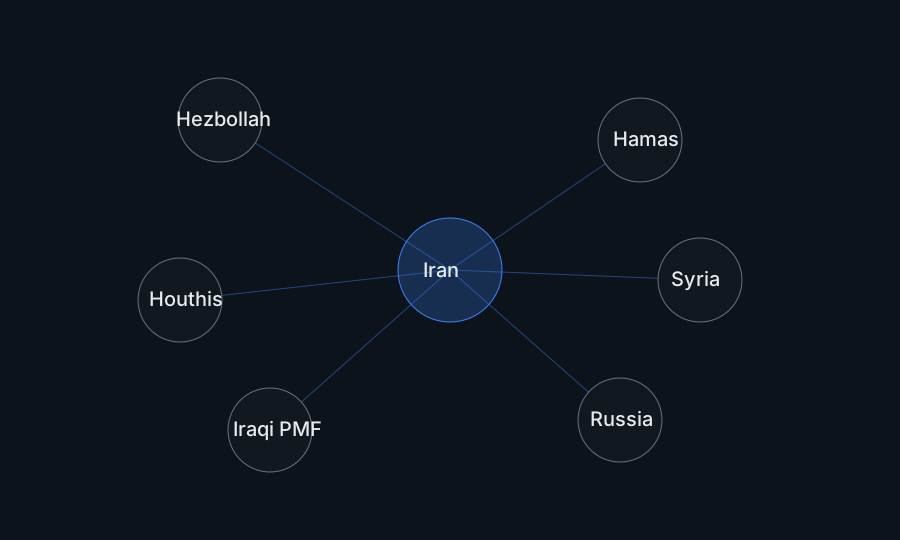
Who are Iran allies in the Middle East is not a simple treaty question. Iran's network is layered: formal state relations, semi-formal security partnerships, and proxy or aligned non-state organizations with different command dependence levels.
| Actor | Relationship type | Strategic function |
|---|---|---|
| Hezbollah | Long-term partner network | Deterrence depth against Israel |
| Houthis | Aligned pressure actor | Red Sea and regional signaling leverage |
| Hamas | Political-military alignment with variable operational depth | Adds pressure vectors in Israel's southern and regional security calculus. |
| Iraqi PMF elements | Variable alignment | Theater pressure against US presence |
| Syrian state ties | Security partnership | Logistics corridor and presence continuity |
Searches such as are Qatar and Iran allies or are China and Iran allies illustrate public confusion between tactical coordination and formal alliance. The analytical standard should be issue-specific alignment, not binary ally labels.
Is Iran a Russian ally and is Iran allied with China are high-interest questions that require precision. There is strategic convergence on selected issues, especially sanctions resistance, military technology exchange, and diplomatic balancing in multilateral forums. But convergence does not imply a fully integrated military bloc.
Russia-Iran military cooperation has expanded in areas like drones and defense-industrial exchange narratives, while China-Iran relations emphasize energy and economic continuity. Both relationships are shaped by pragmatic bargaining, not unconditional security guarantees.
| Track | Russia-Iran dynamic | China-Iran dynamic |
|---|---|---|
| Military cooperation | Higher profile in drone and defense-technology exchange narratives. | More limited direct military integration; stronger focus on strategic signaling. |
| Economic ties | Sanctions-driven transactional alignment with constraints. | Energy purchasing and infrastructure-finance positioning. |
| UN dynamics | Frequent diplomatic balancing against Western pressure timing. | Selective support calibrated to broader great-power priorities. |
Search interest in map us military bases middle east reflects a structural reality: proximity shapes deterrence and response timelines. Key basing arcs in the Gulf, Iraq, and broader CENTCOM footprint shorten decision cycles in crises involving Iran's missile and proxy networks.

In UN and diplomatic settings, this triangle can constrain Western pressure speed, but it does not eliminate Iran's structural economic vulnerabilities or regional friction costs.
What happens if US attacks Iran depends on strike scope, target set, and duration. Three broad pathways are useful:
| Scenario | Immediate consequence | Secondary effects |
|---|---|---|
| Limited punitive strike | Short retaliation cycle, missile and proxy signaling | Temporary oil risk premium and heightened force protection posture |
| Extended campaign | Distributed retaliation across regional nodes | Maritime disruption attempts, broader coalition strain |
| Regime-threat perception | Maximum escalatory logic from all available channels | Sustained regional conflict with high market and humanitarian costs |
Any scenario that raises perceived existential risk for Tehran increases the probability of horizontal escalation across proxies and shipping lanes. That is why strategic monitoring must integrate energy corridors, military posture, and nuclear signaling in one framework.
Regional crises intensify because the three principal actors optimize for different outcomes on different timelines. Washington usually prioritizes deterrence credibility, ally reassurance, and freedom of navigation. Tehran prioritizes regime security, retaliation credibility, and sanction leverage. Jerusalem prioritizes preemption windows, defense sustainability, and denial of strategic surprise. These goals overlap in some areas but collide in others, creating recurring instability even when all sides claim to seek de-escalation.
Policy statements can look contradictory because each actor addresses domestic and external audiences simultaneously. A message intended as deterrence reassurance by one side may be interpreted as preparation signal by another. That perception gap is one reason tactical incidents can escalate quickly despite official calls for restraint.
| Actor | Primary objective | Fast trigger for escalation | Most credible de-escalation channel |
|---|---|---|---|
| United States | Protect forces and partners while preserving regional access. | Direct attacks causing US casualties or major shipping disruption. | Backchannel diplomacy paired with visible force protection. |
| Iran | Preserve deterrence and avoid regime-vulnerability narratives. | Perceived existential targeting or strategic-site strike risk. | Calibrated signaling tied to sanctions or security concessions. |
| Israel | Prevent strategic capability growth and reduce multi-front threat. | Intelligence indicators of imminent high-impact capability shift. | Deterrence restoration followed by mediated restraint channels. |
This matrix explains why crisis management must integrate military, diplomatic, and economic tracks at once. Focusing on one track alone often produces temporary calm while underlying trigger conditions continue to accumulate.
Successful de-escalation in this triangle rarely begins with trust; it begins with predictable signaling and bounded objectives. The most effective pattern is reciprocal restraint steps tied to verifiable behavior: reduced strike tempo, protected maritime transit, and reactivated diplomatic channels with clear sequencing. When one side seeks maximal gains during talks, talks usually collapse and deterrence competition resumes at higher intensity.
A practical de-escalation package often includes three layers: military communication to avoid misread maneuvers, diplomatic backchannels for sequencing disputes, and economic signaling to prevent panic in energy and shipping markets. The package is fragile, but it can buy time for broader negotiations if all sides perceive off-ramps as credible.
Readers tracking day-to-day risk should pair this page with the Hormuz market briefing, the nuclear monitoring page, and the historical timeline to see how trigger patterns repeat.
The triangle raises escalation risk by coupling military signaling, proxy pressure, and alliance commitments on compressed timelines. A localized strike can therefore trigger broader regional responses faster than in a simple bilateral crisis.
Iran cooperates with both countries on selected strategic issues, but open-source evidence points to pragmatic alignment rather than a fully integrated mutual-defense alliance.
The most likely pathway is multi-theater pressure: missile and drone signaling, proxy friction, maritime risk spikes, and emergency diplomatic intervention to cap escalation.
A practical escalation dashboard for the triangle should track four signposts together: force-posture changes, message discipline shifts, proxy activity tempo, and shipping-risk repricing. Any single signpost can be noise, but simultaneous movement across all four has repeatedly preceded higher-risk periods. This approach helps analysts avoid overreacting to one-off incidents while still catching meaningful trend shifts early.
Signpost monitoring is most effective when linked to explicit thresholds. For example, sustained proxy strike frequency plus elevated naval escort requirements plus hardened diplomatic rhetoric may justify moving from "elevated" to "high" risk status. Threshold-based methods improve consistency and make it easier to compare current conditions with prior escalation cycles.
The same framework can be used for de-escalation detection: reduced incident frequency, moderated official rhetoric, and restored diplomatic messaging cadence usually indicate that crisis-management channels are regaining traction.
Using consistent thresholds across time helps keep strategic assessment disciplined when public narratives become emotionally charged during active crisis periods.
It also supports clearer cross-team coordination in live monitoring workflows.