
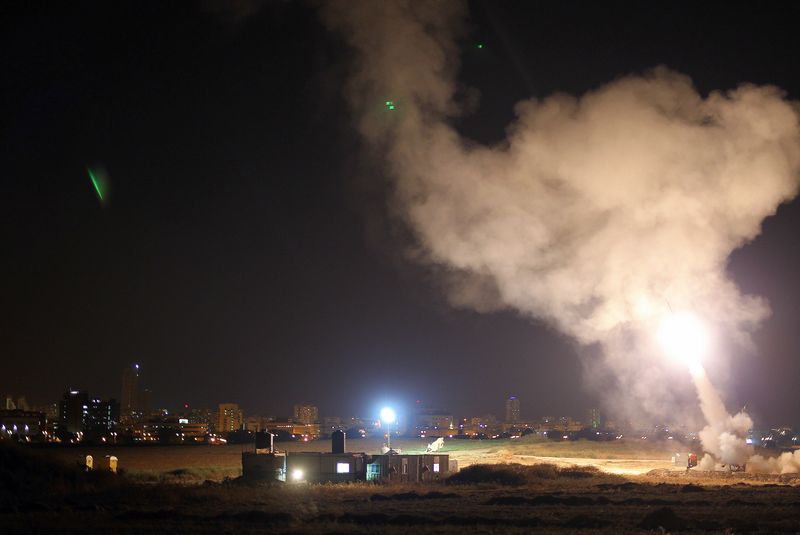
Ballistic Missiles: Range, Payload, and Strike Doctrine
Iran's ballistic missile family includes short- and medium-range systems designed for regional strike depth, deterrence signaling, and salvo saturation. Queries about whether Iran has ballistic missiles are straightforward: yes, and at substantial inventory depth. The harder question is precision and survivability under sustained counterforce pressure.
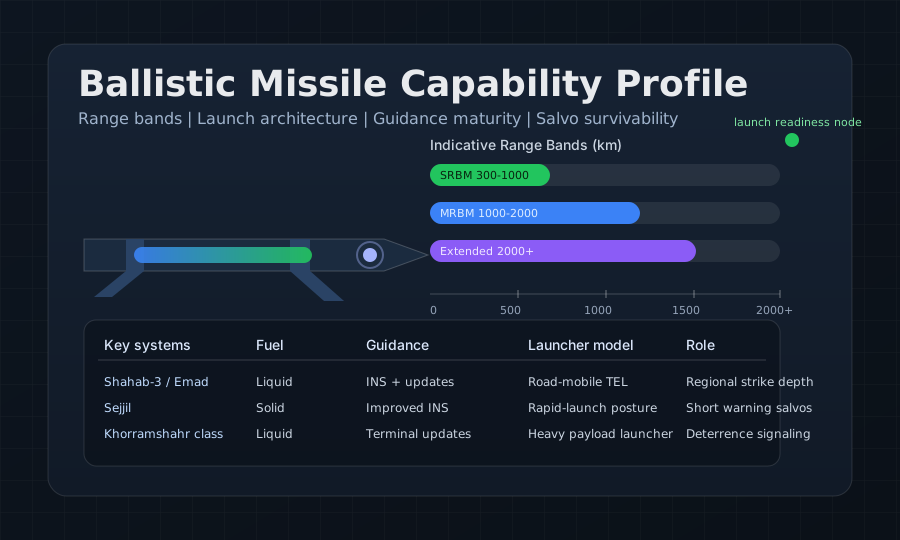
| System | Indicative range band | Payload class | Assessment |
|---|---|---|---|
| Shahab-3 | ~1,000-1,300 km | Medium payload | Legacy backbone with broad regional reach |
| Emad | ~1,700 km class | Improved guidance narrative | Precision claims vary; doctrinal use remains salvo-centric |
| Sejjil | ~2,000 km class | Solid-fuel architecture | Readiness and deployment cadence are key unknowns |
| Khorramshahr | ~2,000 km class | Heavier payload potential | Designed for deterrence signaling and defense penetration rhetoric |
| Fattah (claimed hypersonic profile) | Public claims vary | Unclear in open verification | Operational maturity remains debated |
Can Iran missiles reach US territory? Current open evidence indicates Iran's main operational strength is regional strike range, not assured continental strike. Intercontinental ballistic missile Iran discussions remain largely prospective and developmental in open reporting.
Cruise Missiles: Soumar, Hoveyzeh, and Paveh
Iran's cruise missile development supports lower-altitude penetration options and flexible launch pathways. Compared with ballistic systems, cruise missiles can complicate early warning due to flight profiles, but they also face detection and interception challenges in layered modern air defense environments.
| System | Role | Operational notes |
|---|---|---|
| Soumar | Longer-range land attack profile | Often framed as technology progression benchmark |
| Hoveyzeh | Extended range subsonic strike | Utility tied to ISR cueing and route deconfliction |
| Paveh | Recent-generation cruise option | Publicly claimed precision needs cautious verification |
Drones/UAVs: Shahed-136, Mohajer-6, and Ababil
Iranian drones combine affordability, quantity, and adaptability. The Shahed-136 family especially influenced global attention because of widespread wartime use and reproducible production models. Search demand around shahed drone range and how fast are Iranian drones reflects concern about saturation rather than individual platform sophistication.
| System | Type | Operational history | Assessment |
|---|---|---|---|
| Shahed-136 | Loitering munition | Used in multiple conflict theaters through state or partner channels | Cost-effective for saturation and infrastructure pressure |
| Mohajer-6 | ISR/strike UAV | Observed in regional operations and export contexts | Moderate capability with practical battlefield utility |
| Ababil variants | Short/medium-range UAV family | Long-running service lineage | Flexible but generally less survivable in contested airspace |
Air Defense: S-300PMU2, Bavar-373, and Khordad-15
Iran's air defense architecture is layered and intended to complicate strike planning. The S-300 Iran deployment provides higher-tier coverage at selected strategic sites, while domestic systems like Bavar-373 and Khordad-15 are integrated to create depth and redundancy.
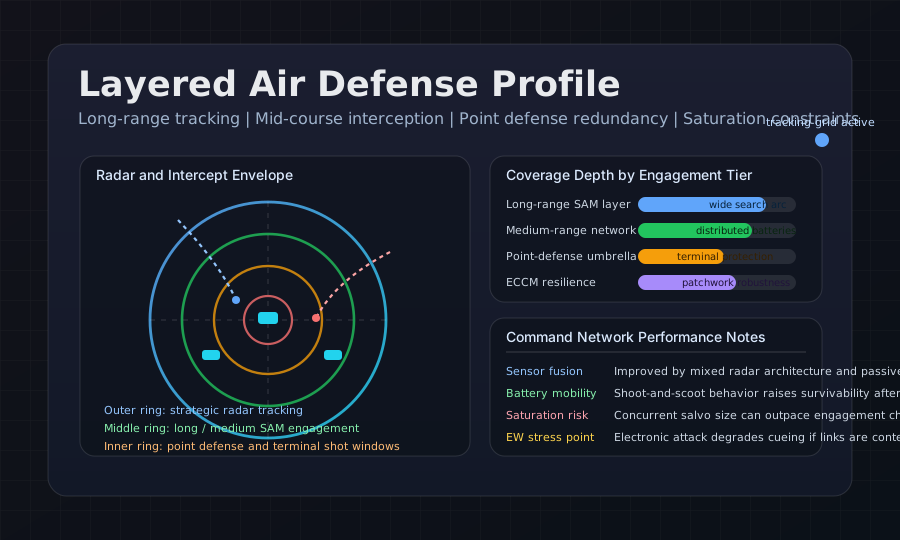
Comparison callout vs Western and Israeli equivalents: Iran's systems can be credible in point or regional defense roles, but battle-network integration, sensor fusion depth, and intercept reliability are generally assessed below top-tier Western architectures.
Naval Systems: Ghadir-Class Submarines and Fast-Attack Doctrine
Iranian navy capabilities center on sea denial, not blue-water fleet parity. Ghadir-class midget submarines, coastal anti-ship missiles, and large numbers of fast-attack craft support a strategy of localized pressure in narrow waters. For analysts asking how big Iran's navy is, displacement totals matter less than chokepoint disruption potential.
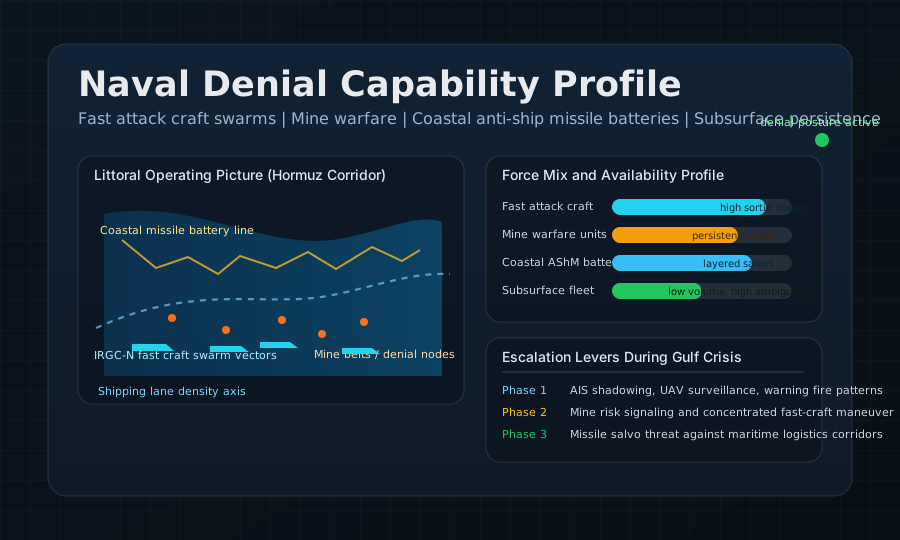
The operational objective is to challenge freedom of maneuver long enough to influence political decision cycles and market behavior, a dynamic explored in the oil and Hormuz briefing.
Comparative Effectiveness vs Western and Israeli Equivalents
| Capability area | Iranian systems advantage | Western/Israeli advantage |
|---|---|---|
| Ballistic salvos | Inventory depth and distributed launcher model. | Higher integrated missile-defense battle management and intercept layering. |
| Drone warfare | Low-cost volume, attrition tolerance, flexible deployment. | Superior counter-UAS sensor fusion, EW, and air defense integration. |
| Air defense | Layered site defense that can slow strike planning. | More mature radar networking, interceptor reliability, and joint kill chains. |
| Naval conflict | High disruption potential in confined chokepoints. | Far stronger blue-water endurance, ASW capacity, and maritime ISR. |
FAQ: Weapons Capability Questions
Can Iran missiles reach the US?
Iran's strongest missile posture is regional. Open-source assessments do not indicate routine assured conventional strike capability against the continental United States.
How many ballistic missiles does Iran have?
Exact counts vary, but open estimates frequently describe inventories in the thousands across short- and medium-range categories.
What is the role of S-300 in Iran?
S-300 batteries provide strategic-site air defense layers and raise the complexity of hostile air campaigns, especially when networked with domestic systems.