
Why does the Iran drone program matter in 2026?
The Iran drone program matters because it converts inexpensive airframes, commercial electronics, military payloads, and launch discipline into strategic leverage. Iran does not need to win air superiority to make adversaries disperse aircraft, harden bases, reroute tankers, spend interceptor inventories, and debate escalation thresholds. A single drone may be slow and vulnerable. A coordinated stream of drones, missiles, decoys, cyber activity, and proxy pressure can make defense far more complicated.
This is why drones belong beside missiles and proxies in any serious model of Iranian power. The site already covers the broader Iran weapons systems stack and the Iran missile range map, but drones deserve a separate lens because they change the economics of air defense. They are useful below the threshold of major war, during retaliatory salvos, and in gray-zone harassment where attribution and proportional response remain politically contested.
Iranian UAVs also compress geography. A one-way attack drone launched from Iranian territory, a vessel, a militia area, or a partner-controlled corridor can pressure energy terminals, bases, and logistics hubs without requiring a conventional air campaign. That creates risk for the same locations discussed in our map of U.S. military bases in the Middle East and shipping corridors covered by the Strait of Hormuz map briefing.
| Strategic function | Drone-program effect | Planning implication |
|---|---|---|
| Cost imposition | Low-cost drones can trigger high-cost intercepts. | Defenders need cheaper layers, not only premium missiles. |
| Persistent pressure | Slow systems can be launched over long windows. | Air-defense crews and sensors face fatigue as well as kinetic risk. |
| Attribution ambiguity | Transfers to partners complicate responsibility. | Response policy must separate launch origin, design origin, and command role. |
| Industrial resilience | Commercial components can be sourced through networks. | Sanctions must target procurement channels and substitution paths. |
What drones does Iran have?
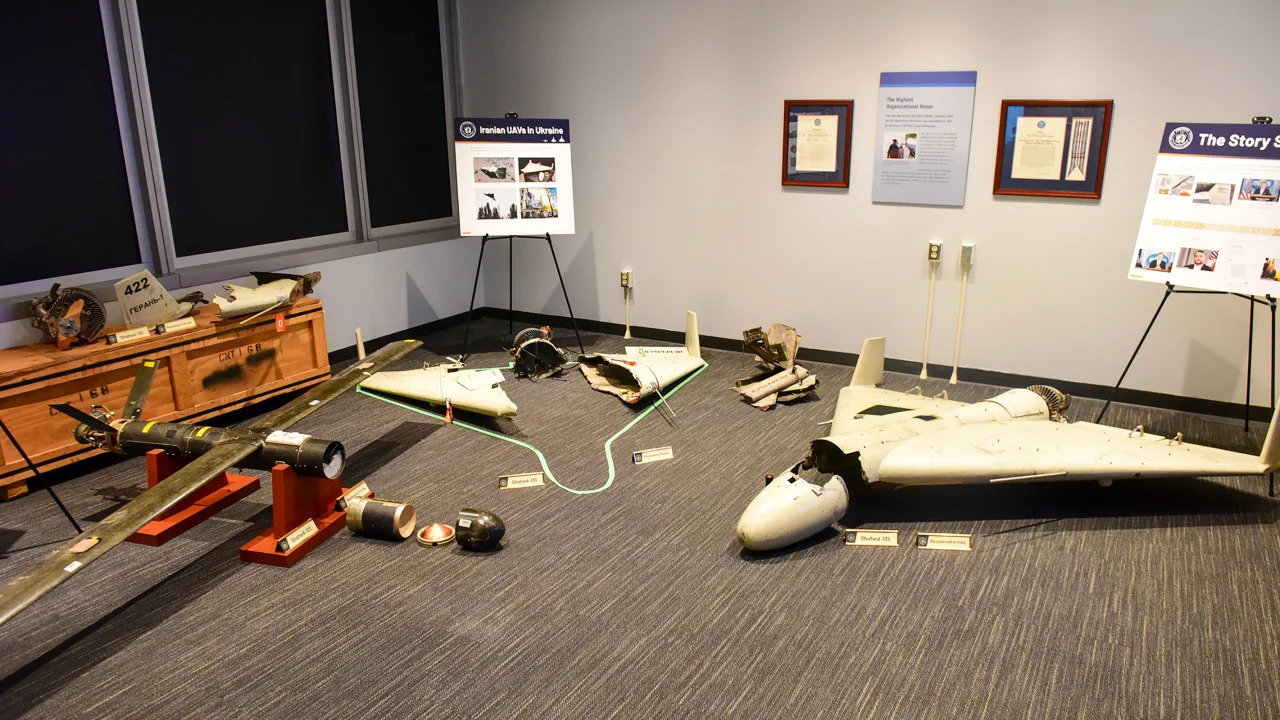
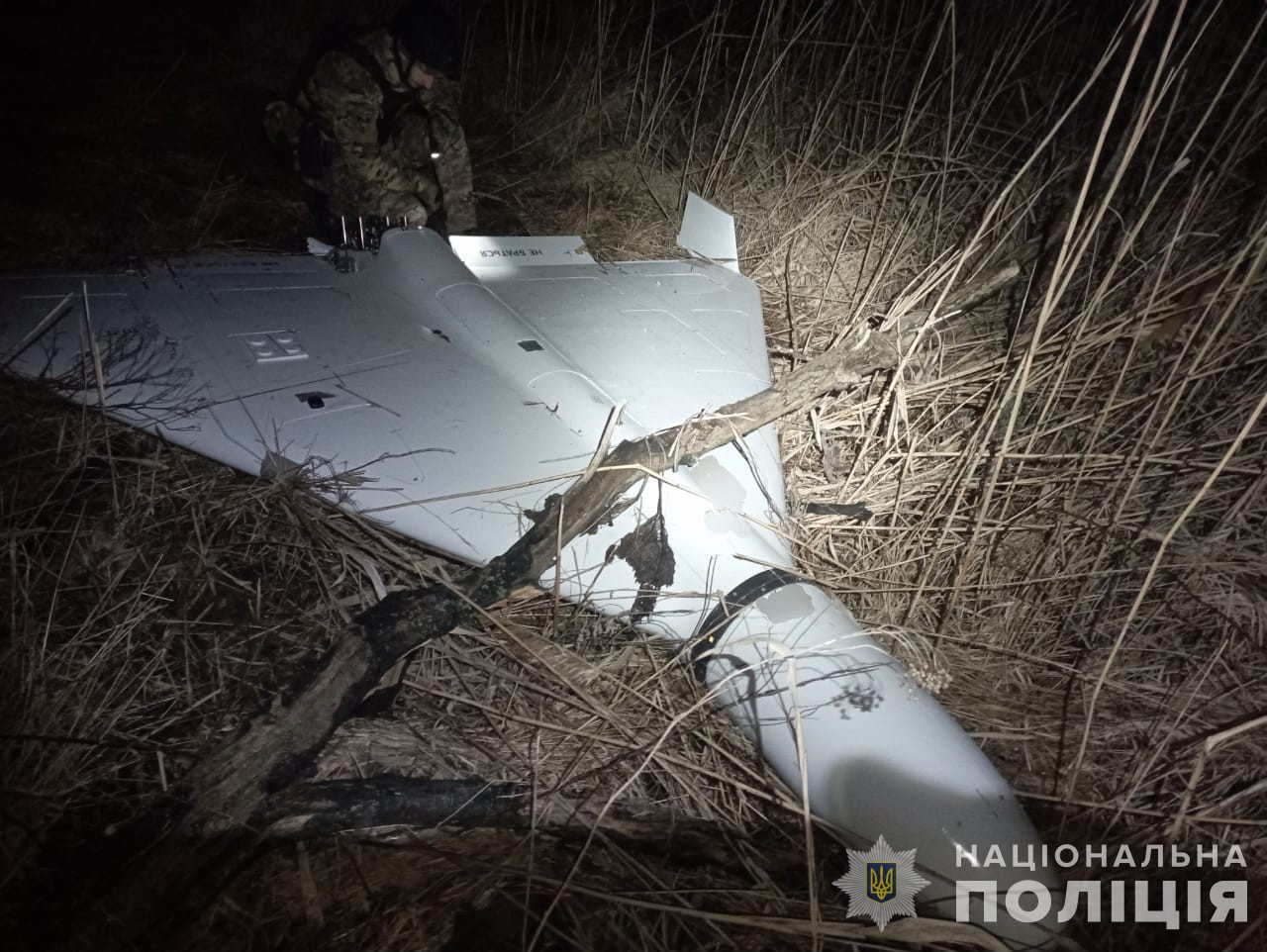
Iran's drone inventory is not one weapon. It is a portfolio. The most visible category is the Shahed family of one-way attack systems, especially the Shahed-131 and Shahed-136 associated with attacks in Ukraine and the Middle East. These are closer to low-cost cruise missiles than reusable aircraft: they are launched toward preselected target areas, trade speed for range and affordability, and are designed to be expendable.
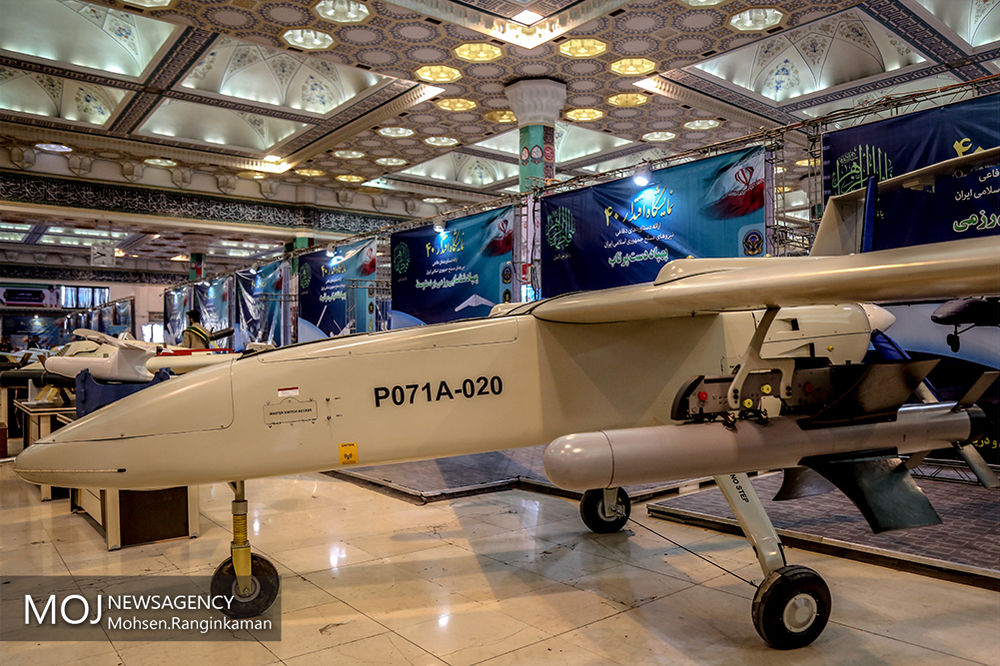
A second category includes reusable armed reconnaissance UAVs such as the Mohajer-6. This class supports surveillance, target development, and limited strike roles. It is more valuable when the operator can keep the aircraft connected to a command network, recover it, and reuse its sensors. A third category includes larger medium-altitude, long-endurance systems such as Shahed-129 and showcased platforms that Iran presents as evidence of technical depth. Some claims should be treated cautiously, but the broader trend is clear: Iran has built a layered UAV ecosystem rather than a single flagship drone.
The distinctions matter because each category creates a different defensive problem. One-way drones stress radar coverage, acoustic warning, and interceptor economics. Reusable ISR drones pressure border security and maritime surveillance. Larger systems create messaging value even when their battlefield survivability against high-end air defenses is uncertain.
| Drone family | Primary role | Why analysts track it |
|---|---|---|
| Shahed-131 / Shahed-136 | One-way attack, fixed-target pressure, saturation salvos. | Cost-exchange problem for defenders and export relevance to Russia. |
| Mohajer-6 | Reusable ISR and armed tactical missions. | Evidence of persistent surveillance and proxy-transfer pathways. |
| Shahed-129 / larger UAVs | Longer-endurance reconnaissance and strike signaling. | Shows ambitions beyond disposable munitions. |
| Jet or upgraded variants | Higher-speed or modified attack profiles. | Could reduce warning time and complicate defense geometry. |
How far can Shahed-136 drones fly, and how much do they cost?
Open-source estimates for the Shahed-136 often cluster in a broad range band around 1,000 to 2,500 kilometers, with payload, route, fuel load, and variant assumptions changing the number. That range is strategically important because it lets a slow, comparatively cheap airframe reach far beyond a local battlefield. But maximum range should not be confused with guaranteed effect. A drone that can reach a target still has to survive detection, electronic warfare, fighter interception, short-range air defense, and terminal navigation errors.
Cost estimates are similarly variable. Public reporting and defense analysis often place Shahed-style one-way drones in the tens of thousands of dollars, frequently around the $20,000 to $50,000 range. That figure is less important as a precise accounting number than as a cost-ratio signal. If a defender uses a missile costing hundreds of thousands or millions of dollars to defeat a drone costing tens of thousands, the defender can win the engagement while losing the economic exchange over time.
This is the program's central logic. Iran can use drones to consume attention, interceptor stockpiles, radar time, and political bandwidth. It can also combine drones with faster ballistic missiles, cruise missiles, cyber activity, or proxy launches. In mixed salvos, drones may serve as decoys, attrition tools, or pressure instruments while faster systems pursue time-sensitive or hardened targets.
How does Iran produce drones under sanctions?
Iranian drone production works because the program does not depend entirely on the same industrial base required for stealth aircraft, large jet engines, or advanced air-to-air systems. One-way attack drones can use relatively simple airframes, piston engines or small jet options, commercial navigation components, and modular payload sections. That does not make them primitive. It makes them difficult to suppress through single-point sanctions or one-time strikes.
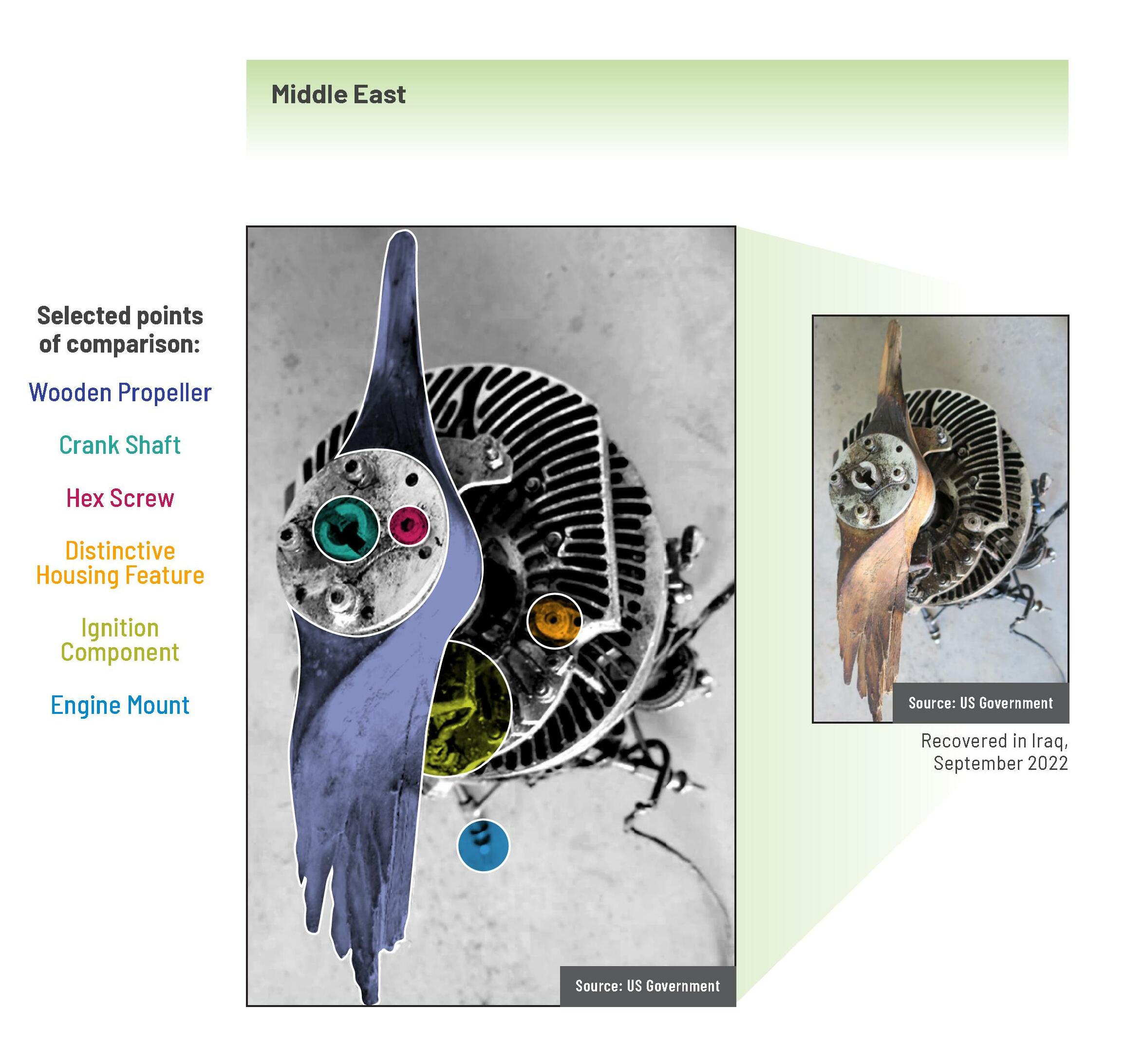
The production challenge for Iran is quality control, reliable engines, navigation resilience, explosive payload integration, and secure procurement. Sanctions can raise costs and slow upgrades, especially for higher-end sensors, satellite-enabled data links, engines, and specialized electronics. But the program can adapt through front companies, transshipment, substitutions, reverse engineering, and partner feedback. This is why Iran sanctions explained is directly relevant to UAV risk: the issue is not whether sanctions exist, but whether they hit bottlenecks that the drone program cannot easily replace.
U.S. Treasury actions in 2026 have continued to target procurement networks connected to Shahed-series UAVs and missile materials. That is a useful indicator. When sanctions identify raw materials, component channels, shipping firms, or aviation-linked suppliers, they reveal which parts of the program outside observers should monitor. The most important watch item is not a single workshop. It is whether Iran can keep replacing components, integrating variants, and moving parts through jurisdictions willing to absorb enforcement risk.
| Production layer | What matters | Best monitoring signal |
|---|---|---|
| Airframe fabrication | Composite or simple structural production at scale. | Workshop recovery after strikes and variant consistency. |
| Propulsion | Piston engines, small jets, spares, and repair cycles. | Engine import routes and domestic substitution claims. |
| Navigation | GNSS, inertial backups, anti-jamming tolerance. | Recovered component sets and battlefield performance under jamming. |
| Payload integration | Warhead size, fuzing reliability, target effect. | Damage patterns and unexploded-recovery reports. |
Why are Iranian drones hard to stop?
Iranian drones are hard to stop for three reasons: they are cheap, they are numerous enough to stretch defenders, and they sit in an awkward middle ground between traditional air-defense categories. They are slower than missiles, but that does not make them easy. A slow object flying low can be hard to sort from clutter, especially when defenders must decide quickly whether to use fighters, guns, short-range missiles, electronic warfare, or cheaper interceptor drones.
The wrong defense mix can turn a successful interception campaign into an unsustainable budget problem. A Patriot-class interceptor may be appropriate for a ballistic missile or high-value threat, but repeatedly using premium interceptors against low-cost drones is exactly the cost curve Iran wants to create. That is why effective counter-drone defense is layered: early warning, passive hardening, electronic warfare, guns, short-range missiles, interceptor drones, aircraft, and rapid repair capacity all have a role.
Electronic warfare is important but not a universal answer. A preprogrammed drone may continue toward a target area even if communications are disrupted. GNSS jamming can degrade navigation, but the effect depends on the system's backup guidance, route, altitude, and target tolerance. Physical interception remains necessary, especially near critical infrastructure. The operational goal is not perfect interception forever; it is to keep attack costs from creating strategic paralysis.
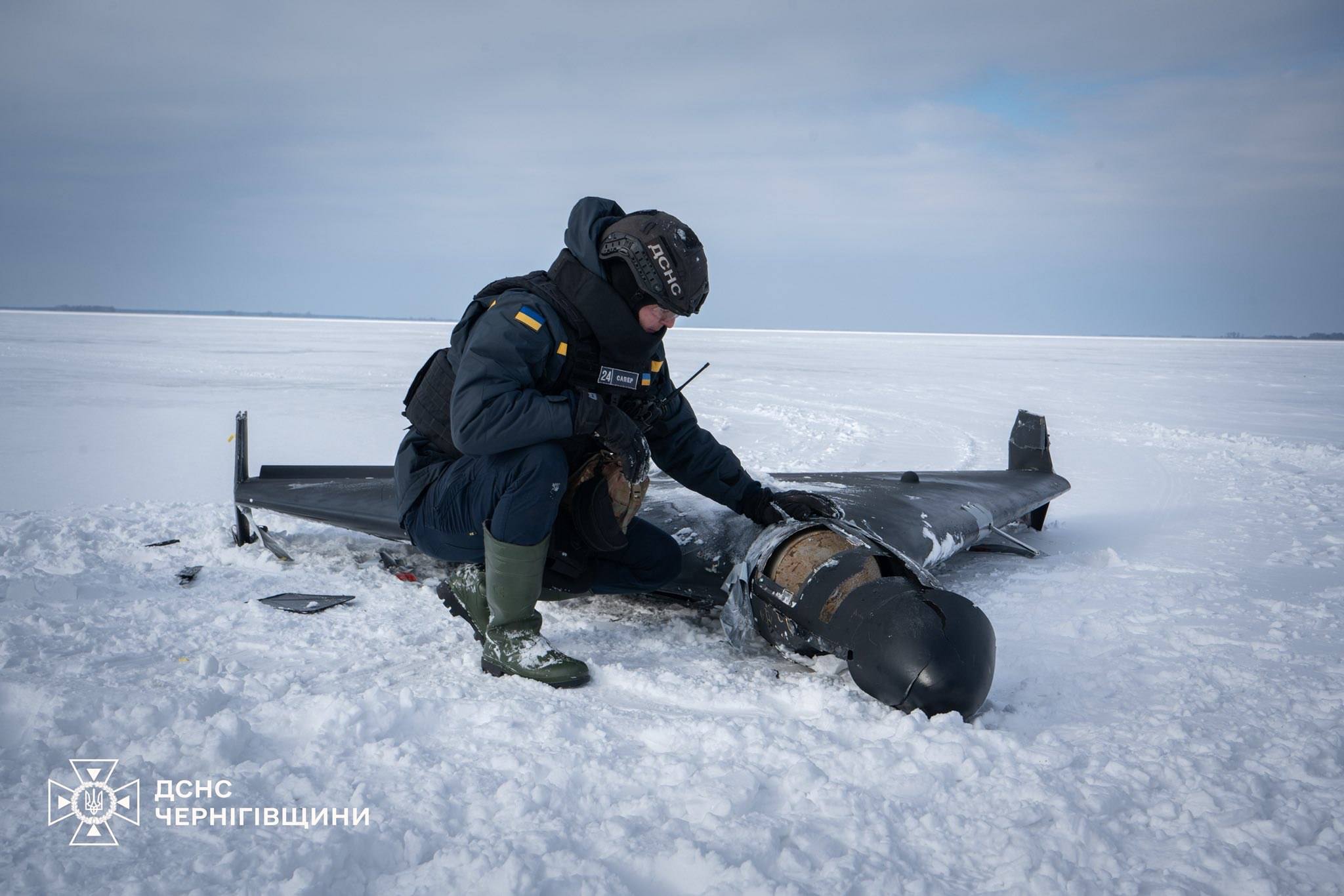
Drone defense is a portfolio problem: the cheapest successful layer should handle the cheapest incoming threat whenever time and geometry allow.
How do Iran drone exports reshape Russia and proxy warfare?
Iran drone exports matter because they convert a domestic asymmetric capability into a global learning loop. Russia's use and production of Shahed-derived systems has given the design family a massive combat-feedback environment. Every interception, failure, navigation change, production substitution, and salvo pattern can feed back into the broader ecosystem. That does not mean Moscow and Tehran have identical needs. It means their cooperation can accelerate adaptation faster than either country would manage alone.
Regional partners and proxy groups create a different problem. A militia does not need the full Iranian industrial base if it receives airframes, components, training, targeting support, or launch know-how. That makes the Iran proxy groups in Middle East network more dangerous during crises: UAVs can widen the number of launch points and force defenders to cover more directions. The Houthis, Iraqi militias, and Hezbollah-linked environments each present different geography, but all benefit from the same concept of distributed pressure.
The Russia track and proxy track reinforce each other. Russia helps prove mass-use concepts under heavy air-defense pressure. Regional partners test maritime, base, and energy-target scenarios. Iran absorbs lessons about what survives, what fails, and what forces expensive defensive reactions. This is how a relatively inexpensive technology family becomes strategically consequential.
| Export pathway | Strategic effect | Indicator to monitor |
|---|---|---|
| Russia-Iran cooperation | Scale, combat feedback, manufacturing adaptation. | New variants, production claims, and recovered component changes. |
| Houthi-linked use | Red Sea and energy-route pressure. | Launch geography, debris matches, and maritime incident patterns. |
| Iraq/Syria militia environment | Base harassment and coalition-force pressure. | Short-warning launches near U.S. or partner facilities. |
| Technology diffusion | Spread of low-cost one-way attack concepts. | Copycat designs and local assembly outside Iran. |
What Iran drone program indicators should analysts monitor?
A useful monitoring framework looks for convergence across five buckets: production, procurement, operational use, defensive adaptation, and diplomacy. Production indicators include new airframe displays, claims of mass integration, facility repairs, and evidence that strike damage did or did not reduce output. Procurement indicators include sanctions designations, customs seizures, engine supply disruptions, and recovered electronics. Operational indicators include salvo size, launch cadence, target mix, flight routes, and how often drones are paired with missiles.
Defensive indicators matter just as much. If Gulf states, Israel, or U.S. forces shift from premium missiles toward cheaper interceptor drones, guns, electronic warfare, and passive hardening, the cost curve changes. A drone program built for attrition loses some leverage when the defender can intercept cheaply and repair quickly. Diplomatic indicators include Russia-Iran defense agreements, public procurement warnings, U.N. reporting, and sanctions coordination among the United States, Europe, and regional partners.
The strongest warning signal is not a single dramatic claim. It is simultaneous movement across multiple buckets: a new procurement network designation, debris showing changed components, higher salvo tempo, and new defensive deployments in the same month. That pattern suggests the program is adapting, not merely surviving.
| Indicator bucket | Track monthly | Why it matters |
|---|---|---|
| Production | Facility activity, airframe displays, serial consistency. | Shows whether losses are being replaced. |
| Procurement | Sanctions, seizures, engine and electronics routes. | Reveals bottlenecks and substitution options. |
| Operations | Salvo size, target categories, mixed missile-drone use. | Shows doctrine, not just inventory. |
| Defense response | Counter-UAV layers and repair capacity. | Determines whether cost imposition succeeds. |
| Diplomacy | Russia-Iran agreements, U.N. language, coalition sanctions. | Signals whether the program is becoming more isolated or more networked. |
FAQ: Iran drone program
What drones does Iran have?
Iran fields one-way attack drones such as Shahed-131 and Shahed-136, armed and reconnaissance UAVs such as Mohajer-6, and larger systems such as Shahed-129 and newer showcased families. The useful distinction is role: expendable attack, reusable ISR, armed reconnaissance, or strategic signaling platform.
How far can Shahed-136 drones fly?
Open-source estimates commonly place Shahed-136 range in a broad band around 1,000 to 2,500 kilometers depending on variant, payload, route, and fuel assumptions. Effective range is narrower when air defenses, jamming, weather, and target precision are included.
How much does a Shahed drone cost?
Public estimates often put Shahed-style one-way drones in the tens of thousands of dollars, with many discussions around roughly $20,000 to $50,000 per unit. Exact costs vary, but the strategic point is the cost mismatch against premium interceptors.
Why are Iranian drones hard to stop?
They are hard to stop because they can be launched in volume, fly at profiles that complicate detection, and force defenders into rapid cost and priority decisions. Layered counter-drone defense works better than relying on a single expensive interceptor type.
Does Iran export drones to Russia and proxies?
Public assessments and reporting link Iranian drone transfers or technology support to Russia and regional partners. The most important risk is the spread of systems, components, launch tactics, and combat feedback rather than the transfer of any single model alone.